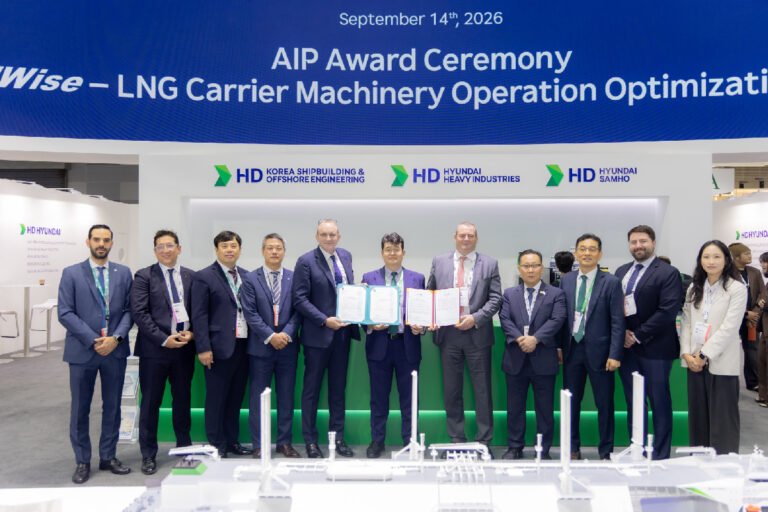


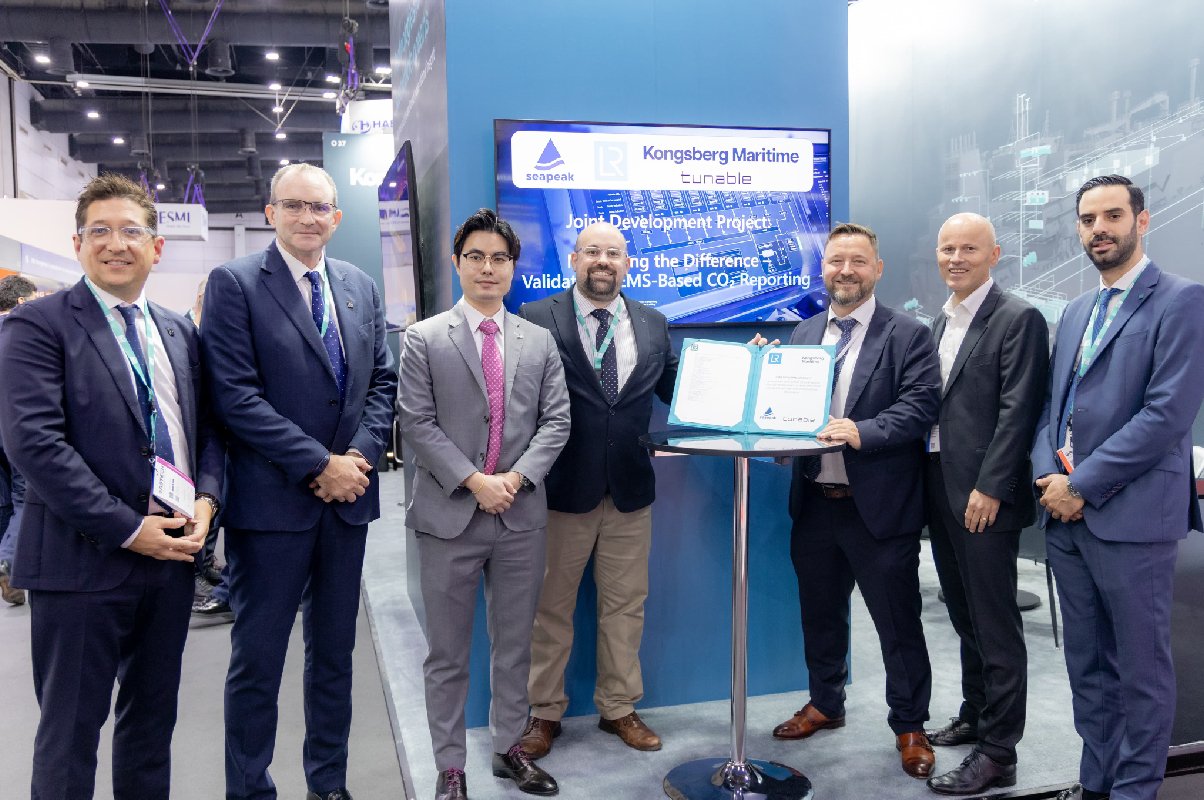
The image shows (left to right) Panos Mitrou, Senior Vice President – Shipping Strategy, LR; Andy McKeran, Chief Growth Officer, LR; Marcus Goh, Business Development Manager – Seapeak; Christofer Willsher, UKI Commercial Manager, LR; Eirik Agren, Sales Director – Green Initiatives, Kongsberg Maritime; Roar Hernes, Business Development Manager, Tunable; Constantinos Chaelis, Global Gas Segment Director, LR.
Lloyd’s Register (LR), Seapeak, Kongsberg Maritime (KM), and Tunable have launched a new joint development project (JDP) to facilitate compliance and independently verify the accuracy of KM’s Continuous Emissions Monitoring System (CEMS), which incorporates Tunable’s gas analysis technology, on board a new LNG carrier.
The partners will compare actual CO2 emissions recorded by the vessel’s CEMS against both engine test bed data and default emissions factors, quantifying the resulting differences and assessing the regulatory applicability of direct CO2 measurement against the relevant IMO and EU emissions reporting frameworks.
The project, announced at Gastech 2026 in Bangkok, will bring together expertise from across the maritime value chain to provide independent evidence on the accuracy and reliability of continuous emissions monitoring technologies for LNG-fuelled vessels.
The initiative will see LR acting as the independent verifier, supporting the evaluation of measured emissions data from a newly built LNG carrier scheduled for delivery in early 2027, with monitoring and data analysis continuing throughout the year.
Through the project, the partners will assess the performance of Kongsberg Maritime’s CEMS under real operating conditions and explore how independently verified measurements can help improve confidence in emissions data used by shipowners, charterers and regulators.
Panos Mitrou, SVP Shipping Strategy, Lloyd’s Register, said: “The industry currently relies on default emissions factors and test bed data to estimate environmental performance. This initiative enables industry stakeholders the opportunity to compare estimated emissions performance against direct measurements from a vessel operating in real world conditions.
“The results will generate valuable insights into the role continuous emissions monitoring can play in supporting more accurate reporting as well as an improved operational understanding that can support emissions minimisation.
“This is exactly the type of collaborative innovation the industry needs as it navigates an increasingly complex and data-driven regulatory landscape.”
James Cruickshank, Director – Marine & Technical Services, Seapeak: “At Seapeak, we are committed to supporting practical, data-driven solutions that enhance both environmental performance and operational efficiency. This project brings together leading expertise from across the industry to advance the understanding of emissions measurement and reporting, using real operational data.
“By collaborating with partners, we aim to evaluate how continuous emissions monitoring can improve emissions insights and support informed decision-making, while also identifying opportunities to further reduce greenhouse gas emissions across our fleet.”
Eirik Agren, Sales Director, Kongsberg Maritime: “Most maritime CO₂ reporting today is based on fuel consumption and standard emission factors rather than continuous, direct measurement. This JDP gives us the opportunity to rigorously compare those established calculations with data from our CEMS under real operating conditions. Integrating emissions measurements with fuel, engine and operational data allows the measurements to be corroborated and placed in context, strengthening confidence in the reported emissions.
“Together with Lloyd’s Register’s independent technical and regulatory perspective, this will help establish the robust evidence needed to assess the accuracy, transparency and regulatory applicability of CEMS-based reporting.”
Roar Hernes, Business Development Manager, Tunable: “Invisible gases contain valuable information. By delivering continuous emissions measurements from a vessel in operation, this project will help generate evidence and insights that support more transparent and data-driven emissions reporting.”