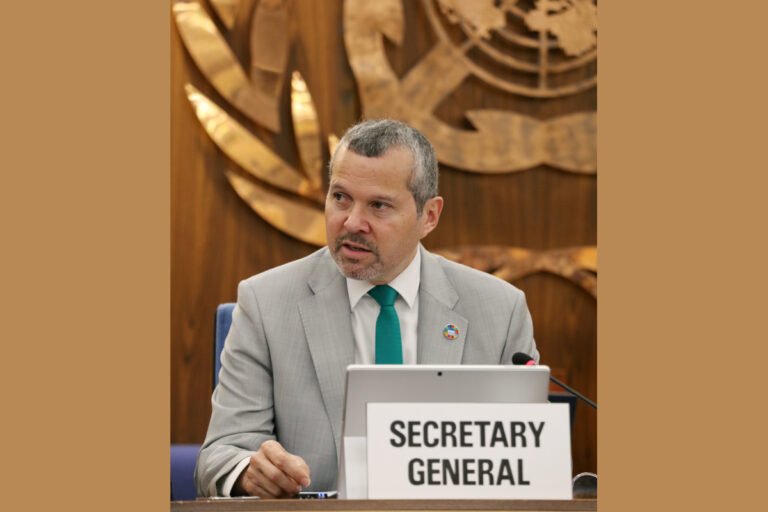
The prevailing sentiment emerging from the recent IMO meeting was one of unprecedented uncertainty not only regarding the eventual outcome of the vote, but also concerning the robustness and clarity of the process itself. This view was, notably, acknowledged by the Secretary-General in his closing remarks. That said, as the dust begins to settle and initial reactions give way to more considered reflection, it becomes apparent that while the short term is likely to remain turbulent, the longer-term implications of the postponement may, in fact, prove to be constructive.
The intense debate—one might even say the controversy—that characterised the meeting ultimately served a valuable purpose. It brought long-overdue attention to a few critical issues and exposed shortcomings that had not previously been given the scrutiny they warranted. Chief among these is the reality that the proposed framework was not yet sufficiently mature for implementation. Several of the practical and commercial consequences it would entail had not been fully assessed. Experience has repeatedly shown that decisions taken under pressure, or in response to circumstances rather than preparedness, rarely deliver optimal outcomes.
A second, and equally significant, concern lies in the coexistence of regulatory regimes at two distinct levels: the global framework established by the IMO and the regional legislation enacted by the European Union. Shipping, by its very nature, is a global industry and cannot function under divergent rules across different continents. Such discrepancies risk imparting a punitive character to regulatory measures—an approach that sits uneasily with both the underlying intent of legislators and the cooperative ethos traditionally upheld by international institutions.
From this perspective, while the postponement may have come as a surprise, it offers a timely opportunity to reassess the situation with a cooler head. It allows policymakers the space to fine-tune the proposed measures and address existing inconsistencies, without in any way diminishing the fundamental importance of the NZF decision. On the contrary, the commitment to NZF should be viewed not merely as a regulatory obligation, but as a personal and collective responsibility for all stakeholders in the shipping industry.
Regarding investments in newbuildings and vessel conversions, it is difficult to argue that a delay of one year will materially disrupt strategic planning. Given the current orderbook, shipyards are already quoting delivery schedules extending two years or more. These investment decisions are increasingly being taken against the backdrop of long-term environmental objectives and the NZF target. In that sense, the industry’s course is already set, and the additional time may well contribute to more resilient, well-considered outcomes.
First and foremost, I fully concur that we are living in an era of pronounced geopolitical turbulence. However, I would go one step further and suggest that such periods will no longer be isolated disruptions interrupting long decades of stability. Rather, they are fast becoming the new normal way of life marked by recurring cycles of tension, realignment, and economic slowdown. In an increasingly interconnected world, developments in one corner of the globe can swiftly reverberate across regions thousands of miles away. Some areas will inevitably come under greater strain, while others may remain comparatively insulated; certain industries will feel the impact acutely, whereas others will demonstrate a greater capacity to absorb and adapt to change. Europe, for instance, currently finds itself at the epicentre of multiple pressures, grappling with conflicts on its doorstep, structural energy dependencies, and political systems struggling to reach consensus—let alone implement it effectively.
Shipping, as has been repeatedly underscored, is by definition an international business and is therefore exposed to almost every geopolitical shockwave. At the same time, its global footprint affords it a degree of flexibility and an ability, in certain cases, to reroute or reposition itself. Claiming to have absolute answers on how to guarantee safe and uninterrupted trade routes amid escalating global conflicts would require nothing short of a fortune teller’s crystal ball. Certainly, quite simply, does not exist. What can be stated with confidence is that the industry must operate in a state of constant alertness, underpinned by adaptability, swift decision-making, and an acceptance of calculated risk. Outcomes are often judged with the benefit of hindsight, using today’s data, while the original decisions were taken in a very different information environment. Even the most sophisticated forecasting models cannot fully capture the complexities of a rapidly evolving reality.
The resurgence of trade protectionism—most notably emanating from the United States and rooted in the competitive dynamics between today’s major economic powers—is undeniably influencing global shipping flows, in some instances to a worrying extent. Yet this is a development that cannot simply be wished away. In my view, the industry is likely to adopt a prolonged “wait-and-see” stance until the current conflict landscape shows clearer signs of stabilisation. Similar efforts have already been observed in the Middle East and in the context of the Ukraine–Russia war, and while progress may be slow, I remain confident that tangible results will eventually emerge. Peace is not forged overnight; the underlying interests and drivers at play today are more complex and divergent than ever before.
Once again, I would stress that the notion of what is “realistic” is inherently relative and heavily conditioned by prevailing developments—developments which, in our era, unfold at remarkable speed and frequently overturn even the most carefully constructed forecasts.
If we broaden the discussion to encompass the full spectrum of fuels currently under consideration or in various stages of development, the list is extensive: ammonia, biofuels, electricity, hydrogen, LNG, LPG, methanol, and even nuclear energy. While not all of these options carry equal weight in the eyes of analysts or the industry at large, they merit inclusion for the sake of completeness and historical perspective.
Research conducted by the Global Maritime Forum, alongside other respected organisations, indicates that scalable zero-emission fuels such as e-ammonia and e-methanol offer the greatest potential to enable the maritime sector to meet its 2040 targets. That said, the supporting value chains for these fuels must be developed within the coming decade if they are to reach commercial maturity. At the same time, long-term cost modelling suggests that dual-fuel vessels operating on liquefied natural gas and ammonia are likely to represent the most cost-competitive solutions up to the mid-2030s, with ammonia emerging as the leading option from around 2037 onwards. Nevertheless, the development and adoption of any new fuel or technology must ultimately pass a fundamental test: economic competitiveness. Without this, the desired outcomes will remain out of reach, and the industry risks further delays—an outcome that serves no stakeholder’s interests.
What both regulators and industry participants must also recognise is that we are currently taking decisions of historic significance for the future of shipping. This is not a moment for passivity; engagement and responsibility are required from all sides.
Regarding the ongoing lack of regulatory clarity, I firmly believe that the shipping industry must advocate for common, globally applicable legislation, implemented on equal terms and with full transparency. It is no secret that the sector currently operates within a fragmented regulatory landscape, marked by inconsistencies and regional divisions. This is not a call to retreat from essential decarbonisation objectives or the NZF agenda. Rather, it is a call to ensure that the measures adopted are guided by the common good and applied uniformly, so that all players are subject to the same rules of the game.
*President, Hellenic Shortsea Shipowners Association