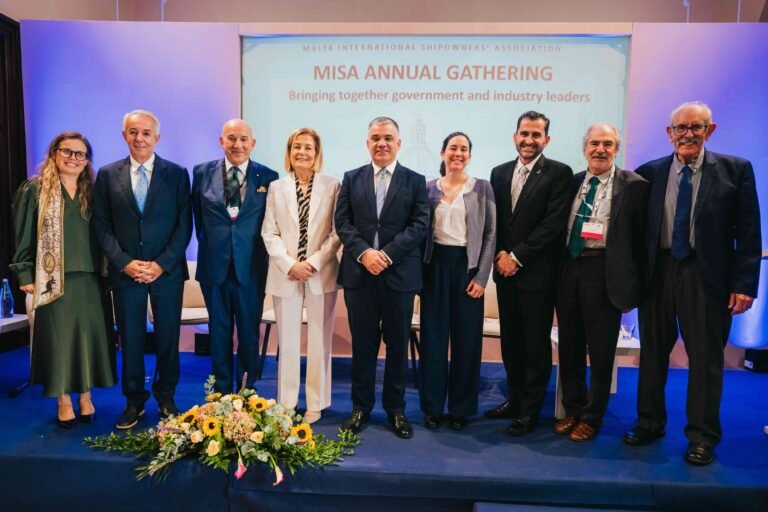


Over the past few decades, Cyprus has transformed into a modern, efficient and fully integrated shipping cluster, today ranking as the world’s 11th largest fleet and the 3rd largest in Europe. As the biggest third-party ship-management centre in Europe – and among the top three globally – Cyprus-based companies manage more than 20% of the world’s third-party fleet.
At the heart of this success is Limassol, home to more than 200 shipping and maritime services companies spanning ship ownership and management, finance, insurance, brokerage, technology, training, and more. This thriving network, backed by a top-quality sovereign flag and an influential voice in international maritime policy, has cemented the island’s reputation as a hub for technical expertise and global collaboration.
Lloyd’s Register (LR) has long supported this growth, working closely with Cyprus’s ship-management community for over five decades to provide classification, advisory, and regulatory guidance that strengthen operations and safety. Today, as the industry navigates the demands of decarbonisation, digitalisation, and evolving regulation, LR’s commitment is clear: to help Cyprus’s maritime leaders adapt, innovate, and remain at the forefront of global shipping.
From our office in Limassol, we work with some of the island’s most prominent ship management companies, as well as owners, financiers and equipment companies. The Cyprus team adopts a personal approach which fits well with local culture and the working environment in Greece, where LR has a larger set-up. Between them, the two teams offer an all-in-one service hub to clients with something for everyone – business, technical, operations and, recently, a growing number of remote survey requests.
One notable example is our collaboration with Mediterranean Shipping Company (MSC), as part of the Methane-Abatement-in-Maritime-Innovation-Initiative (MAMMI), launched in September 2022 by Safetytech Accelerator, which was established by LR. This initiative brings together leading maritime organisations to reduce methane emissions from LNG-fuelled vessels by promoting the adoption of new technologies across the sector.
While our technical expertise is well recognised, it’s our advisory role that is increasingly in demand, especially when it comes to retrofit strategies and emissions reduction.
The transition to low- and zero-carbon shipping is no longer on the horizon; it’s already here. But for many shipowners, particularly those managing existing fleets, the challenge lies in how to make pragmatic, commercially sound decisions today while preparing for a very different future tomorrow. That’s where LR’s combination of global insight and local support makes a real difference.
Earlier this year, LR worked with Tufton to assess the impact of wind-assisted propulsion on their Kamsarmax bulk carrier TR Lady. The vessel had been retrofitted with three Anemoi rotor sails – large, spinning vertical cylinders mounted on the deck, designed to harness the wind and ease the load on the engine. The results, independently verified by LR’s advisory team, showed fuel savings of up to 11% depending on operating conditions. This shows how the right retrofit, paired with a well-matched trading profile, can pay dividends, both financially and environmentally.
For Cypriot-based owners managing similar dry bulk tonnage, this kind of technology isn’t just a headline-grabber; it’s a practical route to lower emissions and improved efficiency. Our role in projects such as these goes beyond compliance, we provide technical modelling, performance verification, and risk analysis to help owners make decisions with confidence.
Propeller retrofits offer another opportunity. As decarbonisation pressures mount, operators are increasingly looking to improve vessel performance through relatively low-cost modifications. LR’s data shows that interest in propeller upgrades, including new designs, boss cap fins, pre-swirl stators and other hydrodynamic devices, has surged four-fold. Yet uptake remains slow, partly due to uncertainty around ROI and compatibility.
That’s something we are actively helping clients address. We recently supported a series of propulsion upgrade assessments across various fleets, identifying viable savings of 5–8% in many cases. While that might not sound dramatic, the cumulative effect across a busy fleet can be significant. Again, it comes down to independent advice, tailored modelling, and an understanding of each vessel’s real-world performance.
With the upcoming IMO Net-Zero Framework (NZF) expected to introduce even more ambitious regulatory shifts, strategic thinking will be more critical than ever. Knowing when and how to invest, what to prioritise, and how to adapt to evolving frameworks is essential. Our Limassol team has been working closely with clients to support compliance with the EU’s Emissions Trading System, optimise CII ratings, and prepare for FuelEU Maritime. These conversations aren’t just technical, they’re strategic, focused on long-term fleet resilience and operational flexibility.
What makes Cyprus unique in this landscape is its concentration of expertise. The island’s ship management cluster brings together technical superintendents, fleet managers and crewing specialists under one roof. It also creates opportunities for knowledge sharing, something LR is deeply committed to.
There’s no shortage of challenges ahead for shipping. But in Cyprus, there’s also a readiness to tackle those challenges, backed by strong partnerships, deep technical capability, and a mindset geared towards progress. LR is proud to be part of that momentum.
As the sector moves forward, our focus is on supporting Cypriot-based owners and managers with trusted insight, practical solutions, and a genuine commitment to long-term success. Whether it’s evaluating new technologies, advising on regulatory pathways, or helping unlock the full potential of existing fleets, LR will continue to be a trusted advisor.
*Client Relations and Business Development Manager for Cyprus, Lloyd’s Register