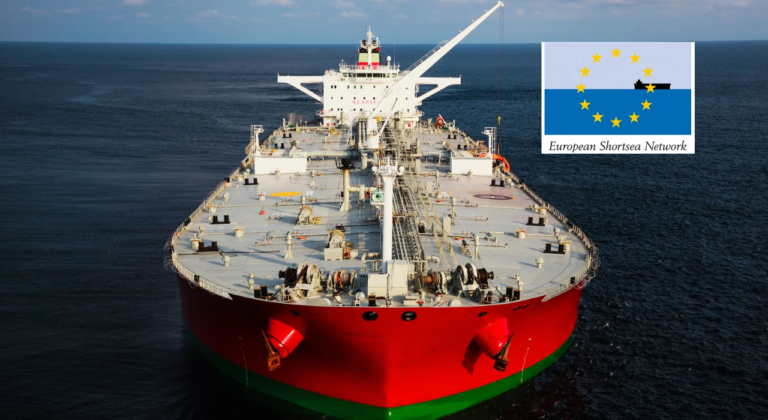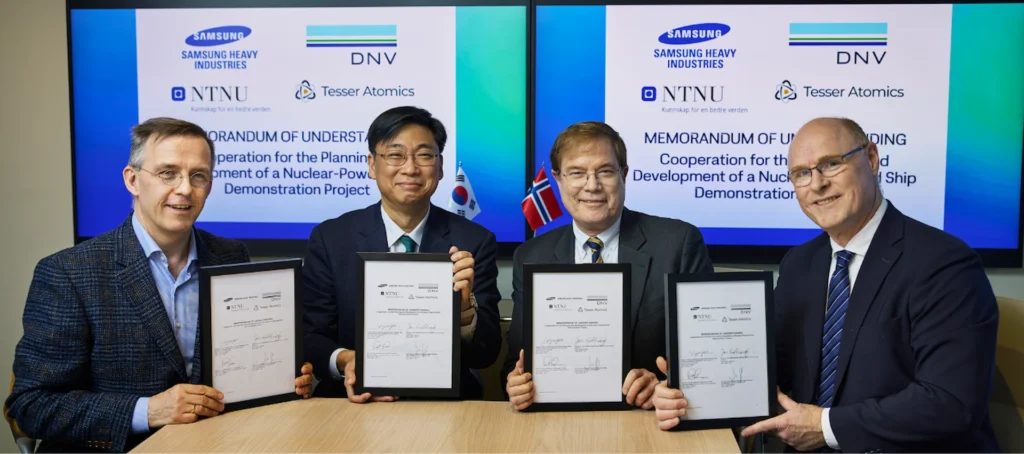
Samsung Heavy Industries (SHI), Tesser Atomics, the Norwegian University of Science and Technology (NTNU) and DNV have signed a Memorandum of Understanding (MOU) to advance the development of a nuclear-powered LNG carrier demonstration project, targeting a commercial route between the United States and Europe.
The agreement, announced by DNV on 23 November 2026, brings together shipbuilding, nuclear reactor technology, maritime classification and academic research expertise to assess the technical, regulatory and commercial requirements of a nuclear-powered merchant vessel.
Developing a transatlantic demonstration vessel
The partners will initially establish a roadmap covering the vessel concept, safety assessment and approval process, with the longer-term aim of identifying a practical route towards design, construction and commissioning.
The proposed LNG carrier would incorporate a marine-adapted fluoride-salt-cooled reactor developed by Tesser Atomics. The project will also serve as a reference for SFI SAINT, Norway’s nuclear-powered vessel research centre led by NTNU, and form part of its broader demonstration programme.
Safety, classification and licensing at the centre
Samsung Heavy Industries will lead the ship concept, integration of the propulsion system and assessment of shipbuilding feasibility and construction methods. Tesser Atomics will take responsibility for reactor and nuclear plant development, including reactor-specific safety and licensing activities.
DNV will focus on maritime safety, hazard identification, risk assessment, classification and verification, helping establish a framework for the vessel’s potential approval. NTNU will coordinate research, funding proposals and the project consortium while contributing to feasibility studies, simulation, modelling and testing.
A potential new pathway for maritime decarbonisation
SHI sees nuclear propulsion as a potential low-emission alternative for shipping, drawing on its experience in marine small modular reactor technologies. DNV highlighted the importance of translating the nuclear propulsion experience accumulated in naval vessels into a viable framework for commercial shipping, particularly in relation to shipbuilding and safety.
The partners intend to explore a commercially feasible design that could eventually be adapted to containerships and other merchant vessel types. However, the agreement represents a development and demonstration initiative; it does not constitute regulatory approval or a confirmed construction order for an operational ship.
Source: DNV, 23 November 2026.