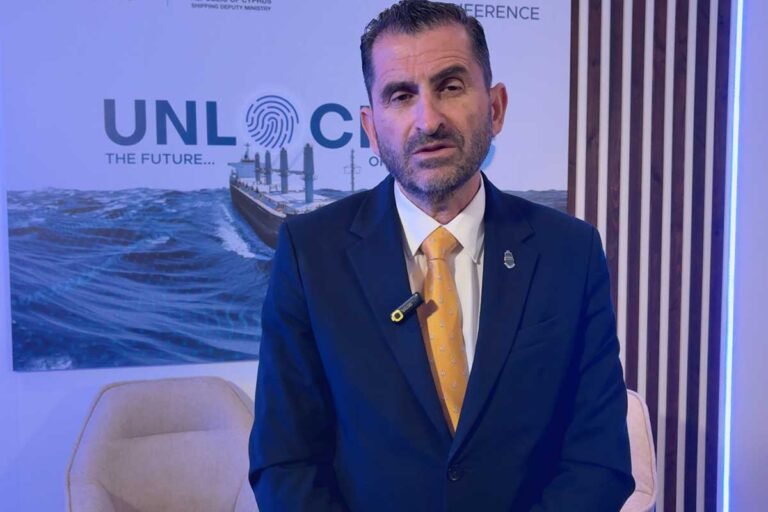
As one of the world’s leading maritime nations, Greece continues to chart an ambitious course for the future of global shipping. In an exclusive interview with NAFS, Deputy Minister of Maritime Affairs and Insular Policy, Mr. Stefanos Gkikas, highlights the government’s strategic priorities: strengthening safety at sea, advancing the digital transformation of maritime administration, and driving the green transition across fleets and ports. From close cooperation with Cyprus and regional partners to bold initiatives in maritime education, island connectivity, and short-sea shipping, Greece is positioning itself at the forefront of sustainable, competitive, and innovation-driven shipping. Looking ahead to 2030, the Ministry envisions a modern, greener, and globally influential Greek maritime sector, firmly anchored in quality, safety, and tradition.
Greece remains one of the world’s top shipping nations. What are your Ministry’s strategic priorities for maintaining and enhancing Greece’s maritime leadership in the coming years?
Greece’s maritime leadership is built on the pillars of quality, safety, and competitiveness.
The Greek government, is committed to enhance the sustainability of our shipping sector through targeted initiatives, including the “greening” of coastal shipping, the modernisation of ship’s registry and administrative services and the development of advanced digital systems for shipping across the maritime domain.
At the same time, as our Minister Vasilis Kikilias keeps saying: “ensuring safety at sea remains a strategic priority”. We are strengthening the Hellenic Coast Guard and enhancing our flag’s compliance programme by implementing a five-year inspection regime for sea-going ships under the Greek flag, ensuring effective implementation of all safety and environmental instruments.
How would you describe the current level of cooperation between Greece and Cyprus on maritime and shipping matters? Are there any new joint initiatives or synergies being planned?
Our long-standing cooperation with Cyprus is close and constructive, covering key areas such as flag, port state control, maritime education, search-and-rescue, as well as the exchange of technical know-how on safety and environmental compliance.
This cooperation extends beyond the bilateral level to include trilateral frameworks with other key Mediterranean countries, such as Israel, through the Sub-regional Marine Oil Pollution Contingency Plan, aimed at ensuring a prompt and effective response to major marine oil pollution incidents. A similar plan is currently under development with Egypt. These forms of cooperation act as a stabilising factor for the promotion of peace and stability, coexistence, and mutual understanding in the sensitive region of the Eastern Mediterranean.
Moreover, we maintain strong collaboration with our Cypriot partners within the European Union and International Organisations. A notable example is our successful bilateral cooperation under the European Territorial Cooperation Programmes (INTERREG), as well as our mutual support for each other’s candidacies within the International Maritime Organization (IMO).
A characteristic case of this close coordination, is Cyprus’s support for a Greek priority within the context of the “IMO Net Zero Framework”, specifically, the inclusion of a clause that secures the option to pass on compliance costs to commercial operators.
Looking ahead, we are exploring the establishment of green maritime corridors between Greek and Cypriot ports, the interoperability of our digital systems (such as e-certificates and single-window reporting), as well as joint training modules on new fuel and ship technologies.
These initiatives are expected to improve efficiency for operators active in both countries, while making a substantial contribution to strengthening the maritime ecosystem of the Eastern Mediterranean.
With decarbonization high on the industry’s agenda, how is Greece supporting shipowners in meeting new environmental and regulatory challenges?
The green transition must be seen as a strategic opportunity for development, rather than an obstacle.
The Ministry of Maritime Affairs and Insular Policy actively supports the shipping industry’s green transition by providing clear guidance on the requirements set by the European Union and the International Maritime Organization, while also promote access to financing for energy-saving solutions, and pilot projects related to the use of alternative fuels. We are leveraging every available European Union funding mechanism to support shipowners and the maritime industry as a whole.
At the same time, we are promoting the creation of collaborative clusters for businesses involved in the production of maritime equipment, as well as for the shipbuilding and repair industry, with the aim of fostering innovation, strengthening competitiveness and driving technological advancement.
In addition, the Ministry has prepared a “Master plan for the renewal of the Greek passenger shipping fleet” which identifies the fleet’s upgrade needs, port infrastructure requirements, and existing investment gaps in light of the European Green Deal commitments. In this framework, we are utilizing 300 million from EU’s Modernization Fund to upgrade our passenger fleet.
On the other hand, we are promoting the replacement of vessels operating on so-called “barren lines” through the “Green Ferries” project, which will be implemented via a Public-Private Partnership (PPP) scheme. This specific approach was selected as the most suitable for delivering a long-term solution that ensures reliable and sustainable maritime connectivity for Greece’s small and remote islands.
What role do Greek ports play in the broader national maritime strategy, and are there plans to enhance their competitiveness through digitalization or green transformation?
Greek ports serve as key transit hubs due to the country’s strategic geographical position, offering alternative gateways to the markets of the Balkans and Europe. The Port of Piraeus, in particular, is one of the closest European port to the Middle East and one of the busiest container ports in the Mediterranean, connecting Europe with Asia and Africa.
There is, therefore, a clear need to adapt port infrastructure to the emerging realities of digitalisation, real-time data exchange, and shore-side electrification.
The Ministry of Maritime Affairs and Insular Policy follows a multi-level governance framework for the upgrade of port infrastructure, aligning national priorities with European Green Deal obligations.
For example, we are developing Onshore Power Supply (OPS) infrastructure in selected ports to reduce emissions.
We are also strengthening digital transformation through the development of a Central Information System (CIS) and a Port Slot System (PSS) to ensure data-driven planning, digitalization of services and improve transparency in coastal shipping services.
In addition, we are planning the implementation of the Ministry’s Digital Transformation, aiming to create a centralized digital platform capable of supporting both the strategic and operational needs of the Ministry across its competency domains.
Among others, this includes major subsystems regarding port digitalization, such as a Central Information System for Coastal Shipping, the development of a European Maritime Single Window environment, cybersecurity tools, the integration of a Business Intelligence (BI) Platform, etc.
The shipping workforce is evolving rapidly. What actions is the Ministry taking to promote maritime education and attract young professionals to the sector?
In today’s environment of geopolitical instability and hostilities in different regions which directly affect the maritime sector, it is of vital importance to create the appropriate conditions for young and highly skilled individuals to become an integral part of the shipping industry. Gender equality, balance of opportunities, seafarers’ well-being, and safety on board are key factors in enhancing the attractiveness of the seafaring profession. Maritime education lies at the heart of the Ministry of Maritime Affairs’ strategic priorities. Having secured European funding for the 2021–2027 programming period, the Ministry is undertaking a wide range of initiatives to enhance the quality and relevance of maritime training. These include the subsidize of both onboard training voyages (A & B) for cadets, the annual provision of financial aid amounting to 3.400,00 € to more than 3,000 eligible students, the modernization of educational infrastructure and simulators in the Merchant Marine Academies (AEN), as well as the development of digital learning platforms and the upskilling of instructors in emerging technologies. A primary goal is to raise both the academic and vocational standards of the Merchant Marine Academies, while also strengthening the training provided through Continuing Training Centers for unemployed seafarers. Moreover, by modernizing educational programs and investing in cutting-edge simulators and training technologies, the Ministry seeks to ensure that graduates are fully equipped with the skills required by the rapidly evolving maritime industry. In a few weeks, a comprehensive new law for the Maritime education, is going to be submitted to the Greek Parliament. The ultimate goal of our strategy is to ensure a sustainable and adequately skilled pool of maritime professionals for the future.
Island connectivity remains a vital national issue. What new infrastructure or policy measures are being introduced to improve inter-island transport and sustainability?
Insularity is a major issue for Greece. More than 110 inhabited islands confirm this, accounting for almost 20% of the total area of Greece and over 15% of its total population. We try to “elevate” Insularity within the European Institutions with the aim to achieve a separate Fund devoted to the needs of European Islands. In this respect, connectivity emerges as a critical issue for the Administration, targeting territorial, social and economic cohesion.
A key objective is to strengthen the competitiveness of island regions, through measures that stimulate the local economy, support job creation, and attract investment.
We are promoting digitalisation and innovation to improve transport services, monitor traffic, and provide better information to citizens.
Sustainable transport is also a central focus, and initiatives have been introduced to promote the use of electric vehicles, develop charging infrastructure, and provide incentives for public transport use.
In parallel, significant investments are being made in the upgrade and expansion of port infrastructure, aiming to enhance accessibility, safety, and connectivity between islands and mainland hubs.
Finally, we are reinforcing the energy autonomy of the islands, by supporting projects in renewable energy sources and energy efficiency, reducing reliance on imported resources and contributing to climate resilience. EU’s Decarbonization Fund is a useful financial tool to this end.
How is the Ministry approaching the increasing role of technology and digital solutions in maritime administration and ship registry modernization?
The Digital transformation of Ministry of Maritime Affairs and Insular Policy, funded under Cohesion Fund is under way. This digital platform aims to offer digital solutions for numerous processes, modernizing the way Ministry is currently working and offering multiple benefits for a wide range of stakeholders who are directly or indirectly involved in the implementation of maritime policy.
We are advancing a digital-by-design maritime administration including, e-registry services, e-certificates, risk-based and remote inspections-surveys where appropriate, as well as interoperability with European single-window frameworks. Secure data platforms will reduce administrative burdens for owners, agents, and seafarers.
The objective is a faster, predictable service experience that enhances the Greek flag’s attractiveness.
It is also worth mentioning, the ongoing project “Digitalization of the archives of maritime” which involves the digitization of a significant part of Maritime archives, specifically the Ship Registries of the Central Police Port Authority of Piraeus, the Directorate for Shipping, and the Directorate for Seafarers’ Training.
What are the Ministry’s views on the future of short-sea shipping in the Eastern Mediterranean and its role in regional economic development?
Short-sea shipping is a key pillar for the sustainable development of the Eastern Mediterranean.
For Greece, with its extensive coast and island geography and strong trade links, this mode of transport offers both environmental and economic benefits, as it enables the efficient movement of cargo and passengers while alleviating pressure on the road network.
The Ministry supports the modernisation of Ro-Ro and Ro-Pax fleets, the development of intermodal connections, and the promotion of the Motorways which lead to ports – of the Sea Concept – in other words.
Priority is also given to upgrading ports at key nodes, adopting green propulsion technologies for short-distance routes and implementing targeted incentives that enhance frequency, reliability, and cost competitiveness in regional trade.
By enhancing short-sea shipping, we aim to strengthen regional integration, reduce road congestion and emissions and create new opportunities for commerce and employment across coastal communities.
Looking ahead to 2030 and beyond, how do you envision the evolution of Greek shipping and the role of your Ministry in shaping that future?
By 2030 and beyond, we envision a greener, more digital and even more competitive Greek shipping sector, anchored by a quality, safety-first flag and a world-class Maritime Cluster.
The Ministry’s role is to provide a stable regulatory framework, deliver efficient digital services, support safe innovation of ships and ports, and ensure a steady pipeline of skilled maritime professionals. These are the guidelines of our Prime Minister Kyriakos Mitsotakis and Minister Vasilis Kikilias and we are working hard to implement them.
With pragmatic decarbonisation, modern infrastructure, and international partnerships, especially with Cyprus and our EU allies, Greece as a leading maritime power, will continue to be a cornerstone of global shipping, contributing decisively to a sustainable and secure maritime future.
*Stefanos Gkikas, Greek Deputy Minister Of Maritime Affairs And Insular Policy