Global Decarbonization Director At DNV
Regulatory frameworks remain the initial force shaping shipping’s decarbonization journey. Existing key regulations such as FuelEU Maritime, the EU Emissions Trading System (ETS), and the IMO’s Carbon Intensity Indicator (CII) set the requirements to the operators. The revised IMO GHG Strategy 2023 sets the ultimate destination of net zero ‘by or around’ 2050, with checkpoints in 2030 and 2040. Yet, the recent adjournment of the IMO’s NZF vote has unsettled expectations, raising questions about timelines, compliance costs, and whether regional regulations will proliferate in the absence of global alignment. Further to these regulatory incentives, commercial requirements, stemming from the ESG focus of charterers and cargo owners, are driving shipowners to reduce greenhouse gas (GHG) emissions, at a varying degree based on the ship and cargo type.
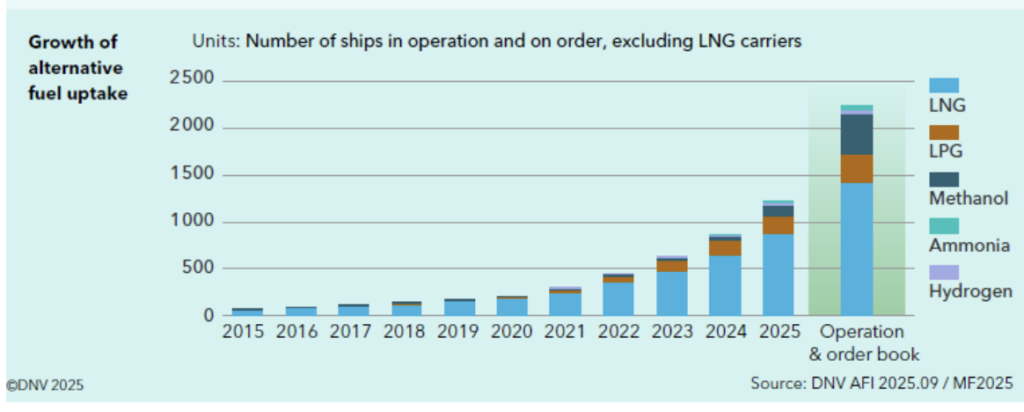
Despite this uncertainty, progress is already visible. An increasing number and percentage of newbuild vessels are being ordered which can run on alternative fuels, such as LNG, methanol, or, to a lesser extent, ammonia and hydrogen. Technological and operational energy-efficiency measures reducing fuel consumption and hence emissions are becoming more common, and newer developments such as wind-assisted propulsion systems (WAPS) are gaining traction. While these developments from the shipowners side are encouraging, significant hurdles to shipping’s energy transition remain, most notably uncertainties over the future supply and cost of alternative fuels.
The regulatory outlook adds further complexity. The NZF adjournment has amplified uncertainties confronting shipowners pondering pathways to future-proof fleets for profitability and regulatory compliance, and this has led to some key questions being pondered across the industry. Could the NZF deferral lead to a widening gap between decarbonization front-runners and the rest? Will FuelEU compliance costs now rise as participants seek to bank the current extra credits? Without the centralized control inherent in the IMO regulations, will regional regulations roliferate and lead to inefficiencies and higher costs?
THE NZF POSTPONEMENT
Let’s talk first about what is at stake in the NZF deliberations. Firstly, it is important to note that the NZF has not been cancelled, and it is still too early to fully assess immediate and longer-term implications
of this adjournment. We will know more about the IMO process after its ISWG-GHG 21 and MEPC 84 meetings in April 2026. For now, though, the NZF’s adjournment highlights the need for greater clarity on key points around its practical implementation.
Most prominently, these include lifecycle assessment (LCA) guidelines, including well-to-tank emission factors for LNG and biomethane, and questions about the effective use of the Net-Zero Fund, the proposed IMO mechanism to finance decarbonization projects and support low-carbon fuel development. Either way, a decision is expected to be made at some stage in the future on the NZF. Whatever consensus emerges from this will have a significant effect on the nature and scale of uptake on alternative fuels, energy-efficiency measures, and carbon capture technologies over the coming years.
SUSTAINING DECARBONIZATION
While the NZF delay clearly adds uncertainty, there is no change in the ultimate decarbonization targets as laid out in existing strategies and regulations including those from the IMO and EU. The level of ambition towards decarbonization varies from one ship type to another. We see containerships, car carriers, cruise ships having a very high uptake, while tankers and bulk carriers are on the lower side.
Clearly too, for operators in market segments hitherto slow to embrace alternative fuels, the NZF deferral creates more time to understand the available technologies and to act when required for sustained regulatory compliance. The postponement also represents an opportunity for the industry to collaborate and develop realistic, pragmatic solutions that can build consensus and strengthen the NZF.
THE 2020 MILESTONE
As laid out in the IMO’s 2023 strategy, the first major checkpoint – a 20% reduction in GHG emissions compared to 2008 levels – is already coming into view. While this might already appear overly ambitious to some, some clear results are already visible across the industry. DNV’s Alternative Fuels Insight (AFI) platform finds nearly 1,000 alternative-fuelled vessels operating as of 2025, and more than 1,100 more on order and set to enter operations by 2030. This clear shift in industry commitment and
capability challenges fuel producers and related industries to speed up their progress. Although any ship could decarbonize by using low-GHG biodiesel, this investment in alternative-fuelled vessels means that an emerging portion of the fleet has the capability to do so using non-oil fuels, such as LNG, methanol, LPG, ammonia, or hydrogen. As shown in the Maritime Forecast to 2050, by 2030 alternative-fuel capable vessels will have the capacity to burn around 50 Mtoe per year of non-oil fuels, a significant portion of the total annual fuel consumption of 280 Mtoe. If these ships ran only on green versions of these fuels, it would represent double the 25 Mtoe of consumption estimated to meet the IMO’s 2030 GHG intensity base target.
However, shipping currently consumes an estimated 1 Mtoe per year of low-GHG fuels, highlighting a significant gap between technical readiness and fuel availability, which is now the central challenge for the industry. While investments in dual-fuel engines have surged, production and infrastructure for low- GHG versions of fuels, such as methanol, ammonia, hydrogen, and biofuels, has lagged. Much of this is down to risk. Shipowners face higher upfront costs for alternative-fuel capable vessels, yet most newbuilds are dual-fuel, allowing continued use of conventional fuels and limiting downside risk. Fuel producers, however, require massive capital for plants and distribution, with returns uncertain before markets have fully materialized.
By 2030, the total supply of low-GHG fuels is expected to reach between 70 and 100 Mtoe but shipping will have to compete with other industries for its share. Infrastructure progress is also uneven. While LNG bunkering is expanding in line with its plentiful supply, access to fuels like methanol and ammonia remains uncertain. Price is another key barrier. Low-GHG fuels cost far more than traditional bunkers, and willingness to pay a premium is mostly limited to container and car carrier trades. As a result, many owners are hesitant to commit to a single fuel pathway. Confidence depends on clear demand signals, such as long-term offtake agreements with fixed prices and volumes. This can also be enhanced by collaboration, both across shipping and beyond.
For example, green shipping corridors provide a tangible pathway for shipowners to access coordinated fuel infrastructure, while also helping to achieve regulatory alignment, and commercial certainty. Energy efficiency can also go a long way to easing the burden, providing shipowners with the most immediate and cost-effective route to emissions reductions. Energy efficiency is not only a compliance tool but also a competitive advantage, reducing operating costs and enhancing resilience to fuel price volatility.
Examples of this are wide and varied, starting from low hanging fruit, such as slow steaming and weather routing to more technical measures, such as hull and propeller maintenance, machinery optimization, and digital performance management. Going beyond this – and requiring a higher degree of investment – wind-assisted propulsion systems (WAPS) can drive further gains.
STRATEGIC APPROACHES
In summary, it remains important to retain all possible decarbonization pathways.There is no single ‘silver bullet’ solution but a range including fuels, energy efficiency, onboard carbon capture, digitalization, and others. Their adoption depends on multiple factors including fleet type, location, and so on. And while decarbonization is a regulatory necessity, it is also a strategic opportunity. Companies acting early to blend robust compliance frame- works with innovation, operational optimization, and collaborative value-chain engagement will meet emerging net-zero requirements and secure long-term competitiveness. Shipping companies should develop a phased, strategic approach to decarbonization across the short-, medium-, and long-term horizons.
As shown in DNV’s Net-Zero Guide this requires a three-step framework – assessment, strategic planning, and implementation and monitoring – for translating decarbonization objectives into executable actions such as choosing ship designs. Organizational transformation across the value chain is equally important for implementing new technologies and systems. The Net-Zero Guide details an organizational roadmap to ensure long-term compliance and competitiveness. The roadmap encompasses fleet renewal and retrofit strategy, fleet operational strategy to net zero, and structural management of change to overcome implementation challenges. Just as important are external facing practices such as alignment with external stakeholders across regulatory bodies, commercial partners, and the broader value chain to help everyone to scale decarbonization efforts and unlock commercial value.
CONCLUSION
This is a pivotal moment for maritime decarbonization. While regulatory uncertainty and geopolitical turbulence are muddying the waters, stakeholders across the maritime value chain should start preparing early and investigate all solutions for finding cost-effective compliance strategies that align with the complex regulatory landscape for GHG emissions. Success will depend on synchronized progress across ships, fuel supply, and port infrastructure – supported by regulatory clarity, and industry-wide collaboration.By integrating internal best practices with external partnerships and continuous review, companies can build resilience, unlock commercial opportunities, and lead the maritime sector’s green transformation.
References
1 DNV. (2025) ‘Maritime Forecast to 2050’.
2 DNV. (2025) ‘Net-Zero Guide: Practical approaches for global shipping companies’.